
Who Controls Coffee? The Structural Risks Behind the New Wave of Consolidation
Financial consolidation is reshaping the global coffee industry in 2026. From Hartree’s rapid infrastructure acquisitions to the largest branded coffee merger in history, ownership concentration is redefining power, infrastructure control, and systemic risk across the entire coffee value chain.
2/27/202610 min read
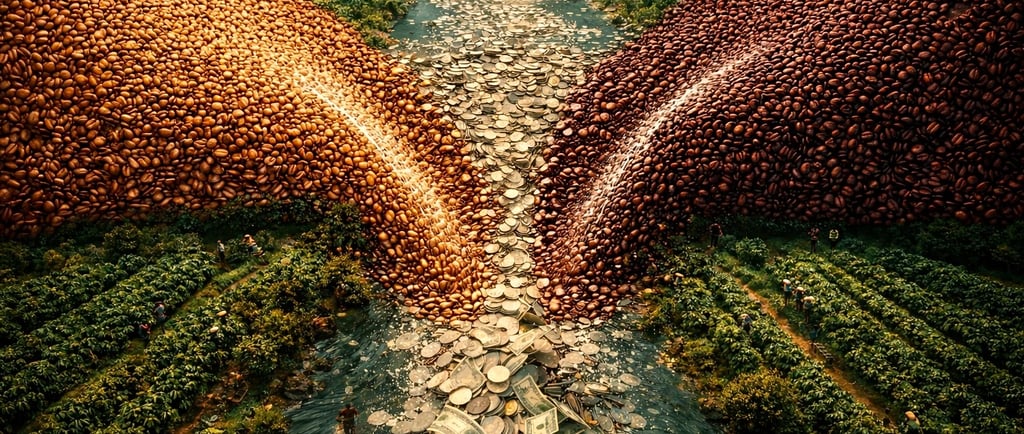

Coffee industry consolidation refers to the structural concentration of ownership, infrastructure, and trading capacity across the global coffee value chain into fewer, financially driven entities. In 2026, this process has accelerated dramatically through a series of acquisitions that are reshaping how coffee is sourced, traded, processed and distributed worldwide — with profound implications for every SME operating in the sector.
I. The Illusion of Diversification in the Modern Coffee Industry
Many coffee businesses believe they are diversified. They work with multiple suppliers. They source from several origins. They maintain relationships with different traders and importers. On paper, the risk appears distributed.
But in 2026, diversification at brand level increasingly masks concentration at ownership level.
When infrastructure and trading capacity are controlled by fewer financial entities, the competitive landscape changes — quietly but profoundly. The names on your contracts may look different. The logos on the invoices may vary. But follow the ownership chain upward, and you may find that your supposedly diversified supply network converges into a remarkably small number of hands.
This is not speculation. This is a pattern that has been building for over a decade — and in the past twelve months, it has accelerated at a pace that demands attention from every SME in the coffee value chain: producers, cooperatives, exporters, importers, independent traders, roasters, distributors, service providers, and emerging brands alike.
Understanding this pattern is not about alarmism. It is about structural awareness.
II. The Trigger: Hartree’s Rapid Consolidation of Coffee Infrastructure
The most significant shift in coffee supply chain ownership in 2025–2026 has not come from a coffee company. It has come from an energy and commodities trading firm based in New York: Hartree Partners, LP.
Before July 2025, Hartree was virtually unknown in the coffee industry. Its core business was energy trading, metals, and financial markets. The firm, jointly owned by senior management, funds managed by Oaktree Capital Management (US) and Brookfield Corporation (Canada), had more than 27 years of experience in proprietary trading and principal investments — none of it in coffee.
Then, over the span of 7 months, Hartree executed 2 acquisitions that have fundamentally altered the architecture of global coffee trading.
Acquisition 1: ED&F Man Commodities (including Volcafe) — July 2025
On July 1, 2025, Hartree completed the acquisition of ED&F Man Commodities’ four core business units: Volcafe (coffee), ED&F Man Liquid Products (molasses, animal feeds, and fish oil), ED&F Man Sugar, and ED&F Man Cotton. The deal had been announced in August 2024 and closed after all regulatory approvals were obtained.
Volcafe alone represents one of the most critical pieces of infrastructure in the global coffee trade. Founded in 1851 — originally as Volkart in Winterthur, Switzerland — Volcafe is one of the world’s largest coffee merchants. Key figures:
1,800+ employees worldwide, including over 250 agronomists providing direct technical support to tens of thousands of coffee farmers.
Buying and selling offices covering over 90% of the world's coffee production.
One of the top three global coffee merchants, sourcing approximately 12% of the global coffee supply.
Specialty trading operations across the US, Europe, and origin countries, serving roasters from single-bag micro-lots to full containers.
A sustainability infrastructure (Volcafe Way, Volcafe Verified) embedded in producing communities across Latin America, Africa, and Asia.
Volcafe is not merely a trader. It is an integrated infrastructure platform: procurement, quality control, processing, risk management, logistics, and sustainability programmes, all operating across the full chain from farm to roaster.
Acquisition 2: Touton — EU Cleared January 2026
Seven months after acquiring Volcafe, Hartree moved again. On August 25, 2025, it announced exclusive negotiations to acquire Touton SA, a leading independent French soft commodity trading company headquartered in Bordeaux, founded in 1848.
On January 23, 2026, the European Commission approved the acquisition under the EU Merger Regulation (Case M.12189), concluding that the transaction raised no competition concerns. The key facts:
Touton processed approximately 104,000 metric tons of coffee in its 2023–24 reporting period, translating to approximately 1.7 million 60-kilogram bags.
700+ employees across 14 subsidiaries and 7 processing and packing plants worldwide.
Touton also traded nearly 10% of the world’s cocoa (308,000 metric tons), according to Reuters.
A strong local sourcing network, long-standing producer relationships, and over 15 years of sustainability programmes, including a fully traceable, 100% sustainable direct cocoa supply chain.
The Combined Picture
In less than twelve months, an entity that had zero presence in coffee has assembled a platform that controls:
Volcafe’s global green coffee procurement network (covering 90% of production origins, ~12% of global supply, 1,800+ employees), plus Touton’s 1.7 million bags of coffee processing capacity, 14 subsidiaries and 7 processing plants — plus significant cocoa, sugar, cotton, vanilla and spice operations.
This is not a coffee company expanding. This is capital consolidating control over logistics, processinga nd trading nodes.
That distinction matters.
III. When Financial Logic Replaces Coffee Logic
Financial consolidation is not inherently negative. Capital investment can bring efficiency, stability and scale. It can fund sustainability programmes, modernise infrastructure, and provide counter-cyclical support during periods of market volatility.
But it changes incentives. And incentives shape decisions.
When a coffee trading operation is owned by a commodity-focused financial firm — rather than by people whose primary expertise and identity is rooted in coffee — the decision-making framework shifts in ways that have structural consequences for the entire value chain.
Allocation Decisions Driven by Margin Optimisation
A financially governed platform manages a portfolio of commodities. Coffee competes with sugar, cocoa, cotton, molasses and energy products for capital allocation. When margins in one commodity outperform another, resources — capital, logistics capacity, management attention — may be redirected accordingly. This is rational portfolio management. But for a coffee producer or roaster whose livelihood depends on consistent access to that specific infrastructure, it introduces a layer of uncertainty that did not previously exist.
Portfolio-Based Risk Management vs. Relationship-Based Trade
The coffee industry, particularly at the specialty and origin levels, has historically operated on relationship-based trade. Exporters know their farmers. Importers know their roasters. Traders build multi-year partnerships based on trust, quality consistency, and mutual investment.
Financial governance tends to favour portfolio-based risk management: hedging, exposure limits, counterparty risk scoring, and capital efficiency metrics. These are sophisticated tools. But they are designed to optimise financial returns, not to sustain long-term relationships with a cooperative in Honduras or a micro-mill in Kenya.
The question is not whether one approach is better than the other. The question is what happens when the infrastructure that facilitates relationship-based trade is owned and governed by entities operating under portfolio logic.
Capital Efficiency vs. Ecosystem Resilience
A financially optimised platform seeks to eliminate redundancy, consolidate operations, and streamline processes. These are strengths in a stable environment. But the coffee industry is not a stable environment. It is subject to climate disruption, regulatory shifts (EUDR, for example), geopolitical instability, and extreme price volatility.
Resilience in the coffee value chain has historically come from diversity: multiple traders, multiple routes, multiple processing options, multiple relationships. When that infrastructure consolidates under single ownership, the system may become more efficient — but also more fragile. A decision made in New York about capital allocation across a multi-commodity portfolio can ripple through coffee communities in Guatemala, Uganda or Vietnam in ways that are difficult to predict and impossible to reverse quickly.
IV. Structural Risks for SMEs Across the Coffee Value Chain
This section is not addressed solely to roasters. The structural risks of infrastructure consolidation affect every participant in the coffee value chain — from the producer to the final distributor.
1. Power Redistribution
Control of infrastructure — processing facilities, logistics networks, trading platforms, and sustainability certification systems — increases upstream leverage. The entity that controls infrastructure sets the terms: pricing, timing, access conditions, quality thresholds.
For producers and cooperatives: when the trader that buys your coffee operates the processing facility where it is prepared, manages the logistics chain that moves it, and controls the sustainability programme your buyers require, your negotiating position changes fundamentally. You are no longer choosing between independent options. You are negotiating within a vertically integrated system.
For independent importers and traders: when a platform controls both the upstream sourcing network and the downstream client relationships, the space for independent intermediaries narrows. You are competing not just on price and service, but against an entity that controls the infrastructure you depend on.
2. Allocation and Access Risk
In a consolidated infrastructure, allocation decisions become strategic. Who gets priority access to the best lots? Who receives capacity first during peak seasons? Who benefits when logistics are strained?
In a scarcity scenario — and the coffee market has experienced significant scarcity in recent years — these allocation decisions are existential for SMEs. A multinational roaster with a long-term contract may be prioritised over an independent specialty importer seeking a specific origin. A cooperative that does not meet the platform’s standardised terms may find its access reduced.
This is not malicious intent. It is the logic of scale. But for smaller operators, the consequences are the same.
3. Margin Compression and Risk Transfer
When ownership consolidates, the entity at the centre of the chain has the structural advantage to capture a larger share of the margin. This compression flows in both directions:
Upstream (toward producers): consolidated buyers can exert greater pressure on farmgate prices, particularly in markets where producers have limited alternatives.
Downstream (toward roasters and distributors): consolidated traders can influence FOB and CIF pricing, shipping schedules, and minimum volume commitments in ways that reduce the flexibility of smaller buyers.
Perhaps more importantly, volatility itself tends to be redistributed. When a large financial platform hedges its own exposure, the unhedged risk does not disappear. It migrates to the participants with the least capacity to absorb it — typically, the smallest operators at both ends of the chain.
4. Standardisation of Terms
One of the less visible consequences of consolidation is the standardisation of commercial terms. A large platform operating across multiple origins, multiple commodities, and multiple markets tends to develop uniform contracts, uniform compliance requirements, and uniform quality protocols.
For many SMEs, particularly in specialty coffee, competitive advantage lies in flexibility: custom contracts, tailored quality specifications, negotiated payment terms, personalised logistics arrangements. When the infrastructure provider standardises these elements, the space for differentiation shrinks.
This particularly affects specialty traders and emerging brands whose business models depend on sourcing coffees that fall outside standardised parameters.
5. Strategic Dependence
An industry built on differentiation may become structurally dependent on consolidated infrastructure. When a single entity controls a significant portion of the processing, logistics, and trading capacity in a given origin, alternatives become scarce.
For a roaster in Europe seeking to diversify sourcing: if Volcafe and Touton are now under the same ownership, and that ownership also controls processing facilities and logistics in key origins, finding a genuinely independent alternative requires more effort, more cost and more risk.
For a producer cooperative seeking to access premium markets: if the infrastructure that connects you to those markets is consolidated, your ability to negotiate independently is constrained.
Strategic dependence does not mean captivity. But it means that the cost of exercising alternatives increases — and for SMEs operating on thin margins, that cost can be prohibitive.
V. Another Signal: The Rise of Global Coffee Giants
The Hartree case is the most structurally significant development in coffee supply chain consolidation in 2025–2026. But it is not the only signal.
On August 25, 2025, Keurig Dr Pepper (KDP) and JDE Peet’s announced a definitive agreement for KDP to acquire JDE Peet’s in an all-cash transaction valued at approximately $18 billion (€15.7 billion). The resulting entity, to be called Global Coffee Co., will become the world’s largest pure-play coffee company: approximately $16 billion in annual net sales, over 50 brands (including Keurig, Jacobs, L’OR, Peet’s, Douwe Egberts, Stumptown and Intelligentsia), operating in more than 100 countries with 40+ manufacturing facilities. The offer was formally launched on January 15, 2026 and closing is expected in Q2 2026.
This merger reinforces the same pattern at brand and distribution level: scale and capital integration are accelerating across every layer of the coffee industry. Between Nestlé (Nespresso, Starbucks retail rights) and the forthcoming Global Coffee Co. (Keurig + JDE Peet’s), the global branded coffee market is moving toward an increasingly concentrated structure.
VI. What This Means for the Next 5–10 Years
The developments described above are not isolated events. They represent a structural shift in how the coffee industry is organised. For SMEs, understanding this shift is a matter of strategic survival.
Infrastructure as Strategic Moat
Control of physical infrastructure — processing facilities, warehouses, logistics networks, port access — is becoming the most defensible competitive advantage in the coffee industry. The entities that own infrastructure control access to the market. For SMEs, this means that infrastructure awareness must become part of strategic planning, not an afterthought.
Ownership Transparency as Strategic Intelligence
In a consolidating industry, knowing who owns what is no longer a matter of curiosity. It is strategic intelligence. When your supplier, your logistics provider, and your certification body are all — directly or indirectly — connected to the same parent entity, your risk profile changes. Mapping ownership structures across your supply chain is an urgent priority.
Structural Awareness, Not Just Operational Efficiency
Most coffee SMEs are focused on operational efficiency: better sourcing, better roasting, better marketing, better pricing. These remain essential. But they are insufficient if the structural environment in which you operate is shifting beneath your feet.
Structural awareness means understanding how ownership concentration, infrastructure control and financial governance are changing the rules of the game — and positioning your business accordingly. It means asking not just “How do I optimize my operations?” but “How resilient is my business model to structural changes in the industry I operate in?”
Diversification Defined by Ownership, Not Logos
The most important lesson of the Hartree case is that diversification must be measured by ownership, not by brand names. If three of your five green coffee suppliers are ultimately owned by the same entity, you are not diversified. You are concentrated.
This principle applies across the value chain: to producers evaluating their buyer base, to importers assessing their sourcing network, to roasters mapping their supply chains, and to distributors reviewing their supplier portfolios.
VII. A Question for the Industry
Financial consolidation in the coffee industry is not a crisis in itself. Capital brings resources, stability, and efficiency. The question is not whether consolidation is good or bad.
The question is: who benefits, who bears the risk and who controls the infrastructure that connects farm to cup?
If coffee’s future is increasingly shaped by those who control infrastructure rather than those who cultivate relationships — if allocation, pricing, and access decisions are made by financial portfolio managers rather than coffee professionals — then every SME in this industry needs to ask itself a fundamental question:
How should I reposition my business to remain resilient and relevant in a structurally changing industry?
This is not an abstract exercise. The acquisitions described in this analysis are already closed or nearing completion. The structural shift is not approaching. It is here.
The SMEs that will thrive in the next decade will be those that combine operational excellence with structural intelligence — those that understand not only their own business, but the architecture of the industry around them.
That understanding begins with asking the right questions. This article is intended as a starting point.
How I Can Help
I’m Matteo Borea. I help coffee entrepreneurs turn market disruption into competitive advantage. Not with more roasting tips — with strategy, positioning, and sustainable business models built for the realities of the global coffee industry.
If you want to grow your coffee business in a market increasingly dominated by corporate giants, you need a strategic approach. Join my free community of coffee business leaders where we discuss real strategies for independent operators.
→ Read more strategic insights on my blog
Sources
Daily Coffee News — “EU Clears Hartree’s Acquisition of Coffee and Cocoa Trader Touton,” February 2, 2026
Volcafe — “Hartree Partners Announces Closing of Acquisition of ED&F Man Commodities,” July 1, 2025
Touton SA — “Touton Exclusive Negotiations with Hartree Partners,” August 25, 2025
Bloomberg — “French Cocoa Trader Touton in Talks for Sale to Hartree Partners,” August 25, 2025
European Commission — Decision C(2026) 539 Final, Case M.12189 (Hartree / Touton), January 23, 2026
Prism News — “European Commission Clears Hartree Acquisition of French Coffee and Cocoa Trader Touton,” February 2026
Keurig Dr Pepper — Official Press Release: KDP to Acquire JDE Peet’s, August 25, 2025
Keurig Dr Pepper — Offer Launch Announcement, January 15, 2026
Comunicaffe International — “Hartree Partners Announces Closing of Acquisition of ED&F Man Commodities,” July 7, 2025
Volcafe.com — Company Network, History and Values, Volcafe Verified Programme
Touton SA — 2023–24 Sustainability Report
ED&F Man Commodities — “Hartree Partners, LP Acquires ED&F Man Commodities,” July 2, 2025
© Matteo Borea - All rights reserved - Z0145324S