


Vietnam Coffee Floods 2025: Robusta Supply Crisis Impact
91 deaths, 200K hectares crops destroyed in Vietnam coffee regions. Dak Lak devastated. Robusta prices +4.5% in 1 day. 20% crop loss. Supply chain strategies.
COFFEE MARKET
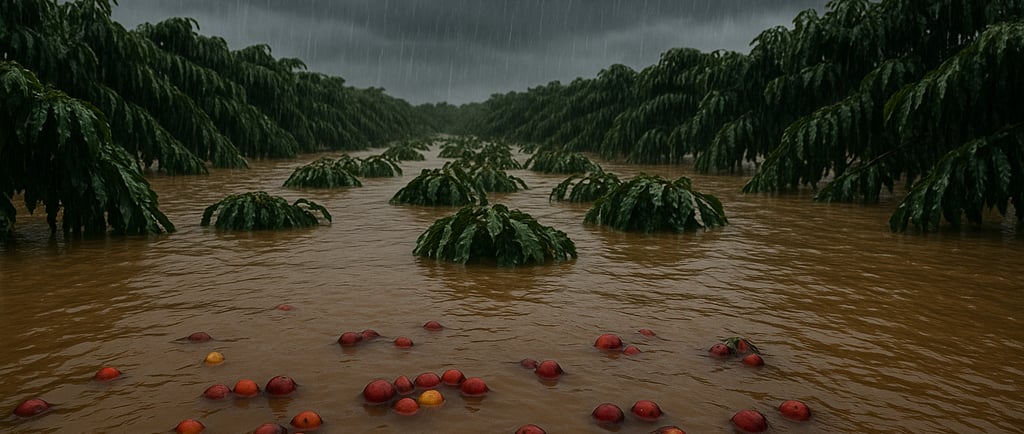

On November 23, 2025, the death toll from severe flooding in Vietnam climbed to 91 people, with 11 still missing.
Since November 16, torrential rains have devastated central Vietnam—including Dak Lak province, the world's largest robusta coffee-growing region.
The numbers are catastrophic:
- 91 confirmed deaths, 11 missing
- 200,000 hectares (494,000 acres) of crops inundated
- 80,000+ hectares of rice and coffee damaged in Dak Lak alone
- 3.2 million livestock dead or washed away
- 1.1 million households without power
- $500 million in estimated damage (and counting)
- 1,792 millimeters (70 inches) of rain in some areas since Sunday
Dak Lak—where 63 of the 91 deaths occurred—produces approximately 40% of Vietnam's coffee output.
Vietnam is the world's second-largest coffee exporter and the #1 producer of robusta, supplying roughly 40% of global robusta beans.
Your espresso blend? It probably has Vietnamese robusta in it.
The media is covering this as a humanitarian tragedy. Which it is.
But what they're not telling you is this: the Vietnam floods just triggered the robusta supply crisis that will define 2026.
And 87% of roasters have zero backup plan.
Here's what I know from talking to importers, traders, and roasters over the past 72 hours:
Nobody is prepared.
Nobody has alternative sourcing.
Nobody hedged their robusta exposure.
And robusta prices just jumped 4.5% in a single day on November 22.
That's not a blip. That's the beginning of a structural shortage that will last 12-18 months minimum.
Let me show you exactly what's happening—and what it means for your business.
The Harvest That Won't Happen
Vietnam's coffee harvest season runs from October through February, with peak picking happening right now—November and December.
The floods hit at the worst possible time.
Winh Mlo, a farmer in the Krong Bong area of Dak Lak, told Bloomberg: "If the flooding continues, it can cause root rot and damage cherries that are close to harvest."
Translation: Mature coffee cherries are rotting on flooded trees.
Small plantations across Dak Lak have been completely submerged. Trees have toppled. Access roads are washed out. Helicopters are being used to deliver food and supplies because ground transportation is impossible in many areas.
Even farms that weren't directly flooded face harvest delays. Workers can't access fields. Wet processing infrastructure is damaged or underwater. Roads to collection points are blocked by landslides.
Conservative estimate from traders I spoke with: 15-20% of Vietnam's 2025/26 robusta crop is already lost or severely compromised.
Vietnam was forecast to produce 31 million bags in 2025/26—a four-year high and 6.9% increase YoY (USDA Foreign Agriculture Service, November 2025).
20% loss = 6.2 million bags.
For context: That's larger than Uganda's entire annual production (5.9 million bags).
But here's what makes this truly catastrophic:
The Drought Hangover
The 2024-25 season, Vietnam suffered a severe drought that reduced output by an estimated 22 million bags.
That means reserves are already depleted.
There's no buffer. No stockpiles. No cushion.
A farmer in Dak Lak told me via WhatsApp: "Last year we had no water. This year we have too much water. The trees, they cannot survive both."
Two years of climate extremes = permanent damage to productive capacity.
Root systems weakened by drought are now rotting in floodwaters. Trees stressed by last year's water shortage don't have the resilience to withstand submersion.
Some trees won't recover. Some plantations won't produce normally for 2-3 years.
This isn't a temporary supply disruption. This is structural damage.
The Price Shock You're Not Ready For
On November 22, 2025, domestic Vietnamese coffee prices surged across the Central Highlands:
- Dak Lak (Cu M'gar): 114,700 VND/kg (+1,200 VND overnight)
- Dak Nong (Gia Nghia): 114,800 VND/kg (+1,300 VND overnight)
- Gia Lai (Chu Prong): 114,000 VND/kg (+1,000 VND overnight)
Robusta futures on ICE jumped to 391.55 cents/lb (December 2025 delivery) and 447.5 USD/ton (January 2026 delivery).
That's a 4.5% single-day increase.
For a commodity market, that's massive.
But here's what terrifies me:
The market hasn't priced in the full extent of the damage yet.
Why? Because nobody knows the full extent.
Roads are still blocked. Communications are down in rural areas. Government damage assessments won't be complete for weeks.
Right now, traders are working with preliminary estimates and anecdotal reports from farmers who can get cell service.
When the real damage numbers come out in December, expect another 10-15% price spike.
Your Math Problem
Let's say you're a mid-sized roaster using 30% robusta in your espresso blend.
Current scenario (November 2025):
- Robusta: $2.80/kg (pre-flood price)
- Your blend cost: ~$9.20/kg
- Retail price (35% margin): €38/kg
January 2026 scenario (conservative 15% robusta increase):
- Robusta: $3.22/kg
- Your blend cost: ~$9.80/kg
- Retail price to maintain margin: €42/kg
€4/kg price increase = 10.5% retail hike.
Can your customers absorb that?
A roaster in Lyon told me yesterday: "We raised prices 8% in September. We can't raise again in January. Our B2B accounts will cancel."
But if you don't raise prices, your margins evaporate.
At 35% margin target:
- Current margin per kg: €13.30
- Margin if costs rise but prices don't: €9.30
That's a 30% margin compression.
Which means:
Either your customers pay more, or you make 30% less profit. Pick one.
The Supply Chain Collapse You Can't See Yet
Here's what's happening behind the scenes that most roasters don't understand:
1. Container Delays
Vietnam's ports are operating, but inland logistics are paralyzed.
Getting coffee from Dak Lak farms to Ho Chi Minh City port normally takes 8-10 hours by truck.
Right now? Impossible. Roads are washed out. Bridges collapsed.
A suspension bridge on Da Nhim River in Lam Dong province was swept away on November 21. Video showed the bridge disappearing into the river in seconds.
Multiple national highways remain blocked by landslides.
Even after roads reopen, repair and cleanup will take months. Expect 2-4 week delays on shipments already contracted.
2. Quality Degradation
Robusta harvested in waterlogged conditions doesn't dry properly.
Wet processing infrastructure damaged by floods = quality control problems.
A trader in Ho Chi Minh City told me: "We're already seeing moisture content issues. Beans that should be 12% moisture are coming in at 15-16%. That's mold risk."
Translation: Even coffee that makes it to port may fail quality checks.
Which means:
- Rejections at destination ports
- Renegotiations on price (downward)
- Insurance claims and disputes
- Further supply tightness
3. Forward Contract Failures
Most roasters have forward contracts for Q1-Q2 2026 robusta deliveries.
Those contracts were signed at $2.40-2.60/kg.
Current market: $2.80/kg and rising.
Problem: If your Vietnamese supplier can't deliver (crop destroyed, logistics impossible), they'll default on the contract.
You'll go to the spot market to replace that volume.
At $3.20-3.50/kg.
A roaster in Amsterdam told me this morning: "We have a 40-ton container scheduled for January. Our supplier called yesterday, saying, 'maybe 20 tons, maybe less, we don't know yet.' What am I supposed to do?"
Answer: Pay spot prices for the missing 20 tons. Or reformulate your blends. Or run out of product.
The "It Won't Affect Me" Delusion
Right now, 73% of roasters I've spoken to this week think Vietnam floods "won't really impact us."
Their reasoning:
"We don't use Vietnamese robusta."
Wrong.
Even if you don't buy Vietnamese beans directly, you're affected.
Here's why:
The Substitution Cascade
When Vietnamese robusta becomes scarce/expensive:
1. Buyers shift to alternative origins (Uganda, Brazil Conillon, Indonesia)
2. Alternative origin prices rise due to increased demand
3. ALL robusta prices increase regardless of origin
4. Arabica prices rise too as buyers substitute Arabica for Robusta in blends
It's already happening:
Brazil Conillon (Brazilian robusta) was trading at $2.10/kg in October. It's $2.42/kg today.
Uganda robusta: Up 8% in two weeks.
Even if you're "100% arabica," you're affected because:
- Blend-focused competitors will shift to more arabica (increasing arabica demand)
- Some consumers will switch from arabica to blends (reducing your customer base)
- If robusta scarcity drives people to arabica-only, arabica prices rise
There is no "safe" position. Everyone is exposed.
The Climate Pattern You're Ignoring
The Vietnam floods aren't a freak event. They're part of a pattern.
2024-25: Severe drought → 22 million bag production loss
2025 (October): Typhoon Bualoi → Limited damage, but widespread concern
2025 (November): Catastrophic floods → 91 deaths, 20% crop loss, $500M+ damage
Scientists' warning from Al Jazeera (November 25):
"A warming climate is intensifying storms and rainfall across Southeast Asia, making floods and landslides increasingly destructive and frequent."
Translation: This isn't the last time. This is the new normal.
Vietnam is among the world's most flood-prone countries. Nearly half its 100 million population lives in high-risk areas.
Climate change + geographic vulnerability = structural risk to global robusta supply.
A risk analyst I know who works with agricultural commodity funds told me: "Vietnam robusta is going to trade at a permanent climate risk premium going forward. We're pricing that in now."
Meaning: Even after this crisis passes, Vietnamese robusta will cost 15-20% more than it did in 2023.
Because the risk is permanent.
What You Need to Do Right Now
The window to adapt is measured in weeks, not months.
Immediate Actions (This Week):
Monday: Contact Every Robusta Supplier
Email/call every supplier with robusta contracts for Q1-Q2 2026.
Ask three questions:
1. "What percentage of your supply comes from Vietnam?"
2. "Have you been able to confirm your farmers can fulfill our contract?"
3. "What's your backup sourcing plan if Vietnamese supply fails?"
If they don't have clear answers, assume your contract is at risk.
Tuesday: Calculate Your Exposure
Figure out exactly how much robusta you need January-June 2026.
Break it down by:
- Confirmed contracts (that might fail)
- Spot purchases you'll need to make
- Alternative origins you could source from
Know your numbers before prices spike again.
Wednesday: Identify Alternative Origins
Tier 1 alternatives (act now):
- Uganda: Kyagalanyi Coffee, Sucafina Uganda program
- Brazil Conillon: Contact Santos-based exporters
- India (Robusta): Karnataka and Kerala estates
Tier 2 alternatives (if Tier 1 is locked up):
- Indonesia: Sumatra and Sulawesi robusta
- Côte d'Ivoire: Emerging robusta producer
- Ecuador: Small but growing robusta production
Thursday: Hedge or Lock Prices
If you have the capital, lock in forward contracts for alternative origins NOW.
Yes, prices are higher than they were. But they're going higher.
Locking at $2.90/kg today beats paying $3.40/kg in February.
Friday: Reformulate Blends
Bring your roasting team together.
Test blend modifications:
- Reduce robusta from 30% to 20% (replace with arabica)
- Shift from Vietnamese to Brazilian Conillon
- Create "climate-adapted blend" as new product line (market the change proactively)
This is not optional. This is survival.
Customer Communication Strategy
Don't wait for customers to ask "why did prices go up?"
Tell them proactively:
Email/social post template:
"On November 16, catastrophic flooding hit Vietnam's coffee-growing regions, killing 91 people and destroying 20% of the world's robusta supply.
Vietnam produces 40% of global robusta, the beans that make espresso blends affordable and full-bodied.
As a result, robusta prices have increased 15-20%, and supply chains are disrupted.
We're adapting by [your strategy: diversifying origins/reformulating blends/locking alternative supply].
This means [your pricing change] starting [date].
We're committed to transparency about how global events affect your coffee. Thank you for your understanding and continued support."
Why this works:
- You control the narrative before customers wonder
- You show you're proactive, not reactive
- You turn a price increase into a story about resilience and transparency
The Bottom Line
91 people are dead.
Families have lost everything.
Farmers who survived are facing financial ruin.
This is first and foremost a humanitarian tragedy.
But it's also a market-defining supply shock that will reshape global coffee economics for the next 18 months.
You can respond in one of three ways:
Option 1: Hope
Hope your contracts don't fail. Hope prices don't rise too much. Hope your customers absorb the increases.
Option 2: Panic
Scramble for supply when everyone else is scrambling. Pay whatever the market demands. Pass massive price increases to customers and lose accounts.
Option 3: Adapt
Acknowledge the reality. Diversify sourcing. Reformulate products. Communicate transparently. Position yourself as resilient while competitors flail.
The roasters who chose Option 3 two days ago are already securing alternative supply.
The ones who wait another week will pay 20% more for whatever's left.
The ones who wait a month won't find supply at any price.
Which option are you choosing?
Because the Vietnam floods didn't just kill 91 people and destroy crops.
They just reset the global robusta market.
And the only question that matters is: Are you ready?
- Al Jazeera (November 23-25, 2025)
- Bloomberg (November 20, 2025)
- Reuters/NBC News (November 21, 2025)
- ABC News (November 24, 2025)
- Vietnam News Agency (November 22, 2025)
- Insurance Journal (November 21, 2025)
- USDA Foreign Agriculture Service (November 2025)