


Brazil Coffee Climate Crisis 2025
Brazil's hailstorms, drought, and floods devastate arabica regions. 10cm hailstones, 26,600 hectares destroyed. Production down 15-20%. Prices hit $4.50-5/lb. Adaptation strategies for Brazil coffee crisis 2025
COFFEE MARKET
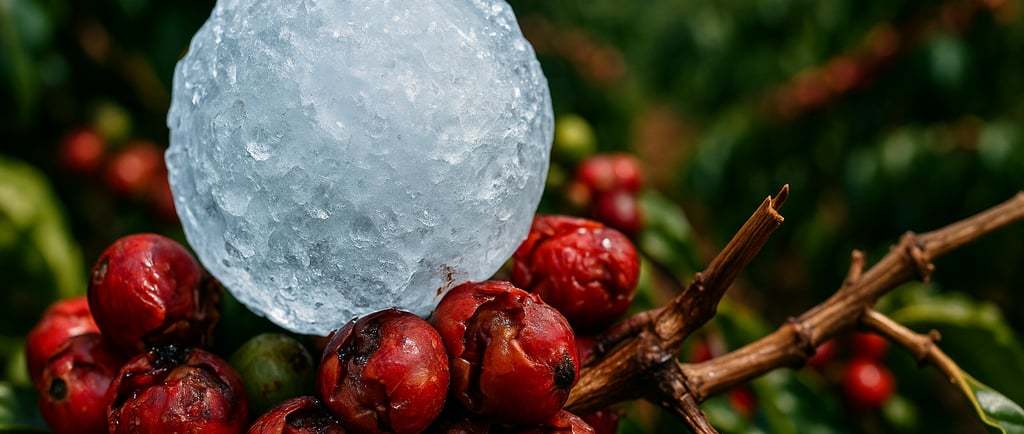
On November 23, 2025, a hailstorm hit Erechim, Rio Grande do Sul, Brazil, producing hailstones 10 centimeters (3.9 inches) in diameter—roughly the size of tennis balls.
Over 150 people were injured. Hundreds of homes damaged. At least 35 schools destroyed. Cars left with shattered windshields across entire city blocks.
The Civil Defense of Rio Grande do Sul declared a state of emergency.
Videos circulating on social media showed hailstones the size of baseballs smashing through car windows, punching holes in roofs, and turning streets into rivers of ice.
This wasn't weather. This was a climate weapon.
And while Erechim isn't a coffee-producing region, what happened there is a symptom of something far more dangerous happening across Brazil—something that's about to devastate your arabica supply.
Because 400 kilometers north, in Minas Gerais—Brazil's largest arabica-producing state, responsible for 75% of the country's arabica coffee—a nearly identical hailstorm struck on July 25, 2025.
That one destroyed 26,600 hectares of coffee plantations.
Entire farms reported 60% crop damage. Trees lost leaves and flower buds. Cherries turned black from hail impact.
And here's what nobody's connecting:
The Erechim hailstorm, the Minas Gerais coffee devastation, the worst drought in 70 years, the May 2024 floods that killed 181 people—these aren't separate events.
They're the same event. And that event is called climate collapse.
Brazil is the world's largest coffee producer, responsible for 40% of global arabica supply—twice as much as Vietnam (the #2 producer) and more than Colombia, Ethiopia, and Honduras combined.
When Brazil's climate breaks, global coffee breaks.
And Brazil's climate just broke.
Let me show you exactly what's happening—and why 2026 is going to be the year arabica becomes unaffordable for most of the market.
The Pattern You're Not Seeing
Here's what happened to Brazil's coffee regions in the past 24 months:
May 2024: Catastrophic Floods
- Rio Grande do Sul: 181 deaths, 2.3 million people affected
- $1.2 billion in damages
- Worst flooding in 80 years
- 1.5 billion cubic meters of floodwater (enough to supply New York City for a year)
- Climate scientists: Event made "twice as likely and 6-9% more intense" by climate change
July 2024 - September 2024: Record Drought
- Worst drought since 1981 (Cemaden disaster monitoring center)
- Minas Gerais, São Paulo, Espírito Santo: Zero effective rainfall for 60+ days during critical flowering period
- Arabica trees aborted flowers
- 2024-25 production estimate cut from 58.8M bags to 54.8M bags
July 25, 2025: Minas Gerais Hailstorm
- 26,600 hectares coffee plantations damaged
- Monte Santo de Minas: 60% of farms affected
- 17 municipalities hit
- Storm lasted 20-40 minutes
- Damage recovery: 2 years minimum
August-October 2025: Extended Drought (Again)
- 20-30 days without rain in key arabica regions (February-March)
- Grain-filling stage compromised
- Lighter, less-dense beans
- Reduced cherry-to-green yields
- Energy reserves depleted for 2026 crop
November 23, 2025: Erechim Hailstorm
- 10 cm (3.9 inch) diameter hailstones
- 150+ injured
- Hundreds of homes destroyed
- State of emergency declared
- Part of "broader instability zone affecting southern Brazil and Paraguay".
You're looking at this list thinking: "Okay, bad weather. It happens."
No. This is not "bad weather." This is systematic climate breakdown.
And it's accelerating.
Why This Isn't "Just Weather"
A climatologist named Francisco Eliseu Aquino told AFP after the May 2024 floods:
"While the region was already prone to extreme climate events caused by the collision of tropical and polar air masses, these events have intensified due to the effects of climate change. The storms are the result of a disastrous cocktail of global warming and the El Niño climate phenomenon."
Let me translate that into economics:
Brazil's coffee-growing regions are experiencing climate volatility that makes production forecasting impossible and long-term supply security nonexistent.
Here's what the data shows:
Temperature Extremes
Arabica coffee plants thrive between 18-22°C (64-72°F). They can tolerate up to 30-31°C (86-88°F) before photosynthesis efficiency drops.
In 2024-2025, many coffee fields in Minas Gerais and São Paulo experienced days reaching 40°C (104°F).
Result:
- Trees aborted cherries
- Increased pest and disease incidence
- Permanent damage to productive capacity
Drought-Flood Cycles
Arabica coffee trees need consistent rainfall during specific developmental phases. They cannot survive
- Extended drought during flowering (August-October)
- Waterlogging during fruit development
- Rapid oscillation between drought and flood
Brazil experienced all three in 2024-2025.
A coffee agronomist writing in Daily Coffee News (November 3, 2025) explained:
"The formation of an arabica crop in Brazil begins practically two years before its harvest, and any disruption along that two-year journey affects productivity."
Translation: The damage from 2024's drought and 2025's hailstorms won't just impact 2025. It will devastate 2026 and weaken 2027.
Trees that lost leaves and flowers in July 2025 won't fully recover for two years. Their energy reserves are depleted. Their root systems are stressed from drought-flood whiplash.
You're not looking at one bad year. You're looking at three consecutive compromised harvests.
Hail Frequency Increasing
The Minas Gerais region has experienced major hailstorms in:
- 2013 (Itamogi: 200-300 hectares damaged)
- 2015 (Carmo do Rio Claro, Cristina)
- 2022 (Nova Resende, Lambari)
- 2023 (multiple locations)
- 2025 (Monte Santo de Minas: 26,600 hectares)
Pattern: Hail events are becoming more frequent and more severe.
Climate scientists quoted in the Minas Gerais impact report (July 2025): "The recurrence of these events indicates that hail in southern Minas Gerais is a persistent and potentially increasing climate risk."
Translation: This will keep happening. And it will get worse.
The Production Collapse Nobody's Pricing In
Let me show you the numbers that should terrify you:
Brazil 2025/26 Arabica Production Forecasts (60kg bags):
May 2025 (Conab initial): 37 million bags
September 2025 (Conab revised): 35.2 million bags (-4.9%)
November 2025 (Volcafe after crop tour): 34.4 million bags (-11 million from September estimate)
November 2025 (Safras & Mercado): 38.35 million bags (but -15% YoY)
Let me put this in perspective:
Brazil's arabica production in a normal "off-year" (biennial low cycle): ~43-45 million bags
Brazil's current forecast: 34.4-38.35 million bags
That's 5-10 million bags missing from expected off-year production.
And this is supposed to be recoverable? Let's look at 2026.
Brazil 2026/27 Outlook:
The same agronomist who wrote about 2025 damage concluded in November 2025:
"As I drive through the arabica regions of Brazil's two largest producing states, it's difficult to imagine the 2026 crop surpassing 2020."
For context: Brazil's 2020 crop was 48.7 million bags.
But 2026 is an "on-year" (biennial high cycle). Production should be 65-70 million bags.
If 2026 only delivers 48-52 million bags, that's 15-20 million bags below expected on-year production.
Combined 2025-2026 deficit: 20-30 million bags.
For comparison: Global arabica consumption growth is approximately 2-2.5 million bags per year.
A 20-30 million bag deficit over two years = 10-12 years of demand growth wiped out.
The Price Shock You're Not Ready For
Arabica futures hit a record high in November 2025, approaching $3.27/lb.
That's already 85% higher than 2023 levels.
But the market hasn't priced in the full extent of Brazil's crisis because:
1. Warehouses still have 2024 inventory (which is running out)
2. 2025 harvest hasn't fully failed yet (it's ongoing, damage becoming clearer weekly)
3. 2026 forecasts are still optimistic (analysts don't believe production can drop that much)
When the market realizes 2026 will be as bad or worse than 2025, expect arabica to hit $4.50-5.00/lb.
Let me show you what that means for your business:
Your Cost Structure Today vs January 2026
Mid-sized roaster (100% arabica, 30 tons/year):
November 2025:
- Green cost: $7.20/kg (at $3.27/lb)
- Total COGS: ~$28/kg (roasted, packaged)
- Retail price (40% margin): €38/kg
January 2026 (conservative $4.50/lb scenario):
- Green cost: $9.90/kg
- Total COGS: ~$31.50/kg
- Retail price to maintain margin: €54/kg
€16/kg increase = 42% price hike.
Can your customers absorb that?
A specialty roaster in Berlin told me yesterday: "We raised prices 12% in September. Our B2B accounts are already complaining. If we raise another 40%, we lose half our wholesale business."
But if you don't raise prices, here's your margin:
Current margin per kg: €15.20
Margin if costs rise but prices don't: €6.50
That's a 57% margin compression.
Which means: Either your customers pay 40% more, or you operate at 43% reduced profitability.
There is no third option.
The Climate Reality Nobody Wants to Discuss
The Brazil climate crisis isn't temporary.
A 2023 study published in Science of the Total Environment on climate risks to Brazilian arabica concluded:
"The impacts of climate change on Arabica coffee have already been observed in Brazil. In the future, a large reduction of up to 60% of the areas currently suitable for coffee cultivation in Southeast Brazil and a decrease of about 25% in the potential yield are indicated."
Translation: By 2050, 60% of the current Brazilian coffee land becomes non-viable for arabica.
But here's what they didn't tell you: "By 2050" doesn't mean it happens in 2050. It means it's happening now, gradually, year by year.
The May 2024 floods? Climate change made them twice as likely and 6-9% more intense.
The 2024-2025 drought? Worst since 1981, driven by El Niño amplified by global warming.
The increasing hail frequency? Result of atmospheric instability from temperature extremes.
Every year, Brazil's coffee climate becomes more volatile, more extreme, more unpredictable.
And every year, production becomes more expensive, more risky, more unsustainable.
What You Need to Do Right Now
The Brazil climate crisis just redefined the global arabica market for the next decade.
You have two choices:
Option 1: Pretend this is temporary, wait for "normal weather" to return, and get destroyed when prices hit $5/lb in 2026.
Option 2: Accept the new reality and adapt immediately.
Here's how:
Immediate Actions (This Week):
Monday: Hedge Your Exposure
If you have capital, lock in forward contracts for Q1-Q2 2026 arabica NOW.
Yes, prices are historically high. But they're going higher.
Locking at $3.50/lb today beats paying $4.80/lb in February.
Tuesday: Diversify Origins Aggressively
Brazil = 40% of global arabica. If Brazil fails, you need alternatives.
Target origins:
- Colombia: 2025 production recovering, 15 million bags (but watch for El Niño 2026)
- Ethiopia: 7-8 million bags, climate-stable for now
- Peru: 4 million bags, growing specialty sector
- Honduras: 6 million bags, Central America alternative
Shift blend composition: Reduce Brazil from 60-70% to 40-50% maximum. Yes, it changes your flavor profile. Reformulate now or get forced to reformulate at crisis prices later.
Wednesday: Build Robusta Capability
I know you're "100% arabica." That's a luxury you can no longer afford.
Develop arabica-robusta blends:
- 70/30 arabica/robusta for espresso
- 85/15 for filter
- Position as "climate-resilient" blends
Why robusta:
- Vietnam production recovering (31 million bags 2025/26, +6.9% YoY)
- Climate-tolerant (thrives 24-30°C vs arabica's 18-22°C)
- $2.80/kg vs arabica's $9.90/kg
Thursday: Radical Price Transparency
Don't hide the climate crisis from your customers.
Lead with it:
"Brazil—which supplies 40% of the world's arabica—just experienced its worst climate disasters in 70 years. Floods killed 181 people. Drought destroyed flowering. Hailstorms leveled 26,600 hectares of coffee farms.
These aren't temporary disruptions. This is climate breakdown.
As a result, arabica prices have risen 85% and will continue rising.
We're adapting by [diversifying origins/developing climate-resilient blends/locking supply now].
Your coffee prices will increase [X%] starting [date]. Here's exactly why."
Friday: Lobby for Climate Action
This sounds abstract, but it's not.
Coffee cannot survive 2°C warming.
Brazil's arabica regions are already experiencing temperatures and rainfall patterns that make consistent production impossible.
Support:
- Carbon pricing legislation
- Agricultural climate adaptation funding
- International coffee climate resilience initiatives
Or accept that in 20 years, arabica will be a luxury product affordable only to the top 10% of consumers.
The Bottom Line
On November 23, 2025, 10-centimeter hailstones fell on Erechim, Brazil, injuring 150 people and destroying hundreds of homes.
It wasn't a coffee region. But it was a warning.
Because 400 kilometers north, the same climate chaos already destroyed 26,600 hectares of arabica coffee.
And across Minas Gerais, São Paulo, and Espírito Santo—the regions that supply 40% of the world's arabica—farmers are staring at trees damaged by drought, weakened by heat stress, and depleted of energy reserves.
2025 production: Down 15-20%.
2026 production: Expected to be worse.
2027 recovery: Unlikely, given ongoing climate volatility.
This isn't a weather problem. This is a climate collapse problem.
And climate collapse doesn't have a "return to normal."
You can adapt to the new reality, or you can be destroyed by it.
But you can't pretend it's not happening.
Because while you're still debating whether climate change is "really that bad," 10-centimeter hailstones are falling from the sky and destroying the world's arabica supply.
The question isn't whether Brazil's climate is collapsing.
The question is: Will you adapt before it takes your business down with it?
---
- The Watchers (November 27, 2025)
- VnCommEx Minas Gerais Hailstorm Report (July 29, 2025)
- USDA Foreign Agriculture Service Brazil Coffee Report (2025)
- Daily Coffee News / Column (November 3, 2025)
- World Press Photo - Brazil Floods Documentation (2024)
- Conab Brazil Production Forecasts (September, November 2025)
- Volcafe Production Estimates (November 2025)
- Science of the Total Environment - Climate Risks Study (2023)
- Bloomberg, Nasdaq Coffee Market Reports (November 2025)