


Fourteen companies just agreed to help farmers. But farmers weren't at the table
The world's largest coffee traders just published two principles to protect farmers. History suggests we should read the fine print.
COFFEE MARKET
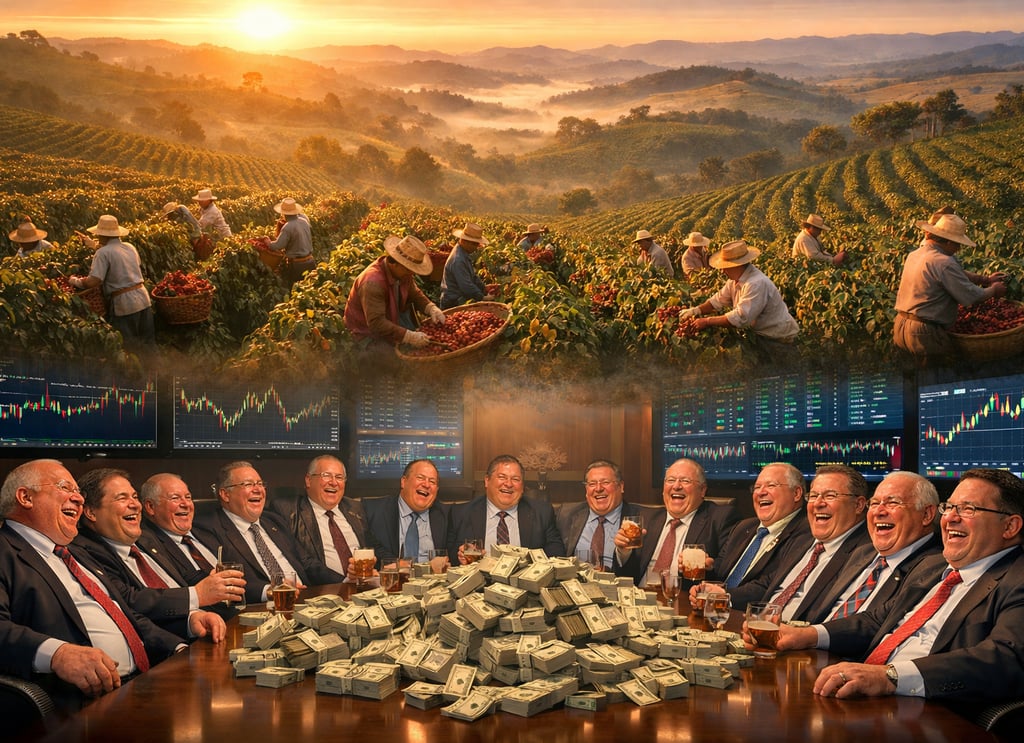
On March 31, 2026, fourteen of the world's largest coffee traders and roasters agreed on two procurement principles intended to improve the long-term economic viability of coffee farmers. The announcement came with the usual institutional warmth: statements about shared responsibility, commitments to move beyond short-term transactions, language about resilient supply chains and farmer prosperity.
I have been watching this industry consolidate, concentrate, and restructure for years. My honest reaction to this news was not relief. It was a question.
Who, exactly, is making these promises? And what does history tell us about whether to believe them?
The announcement and what it says
The document ("Identifying Common Procurement Principles Specific to Coffee") was published by the Global Coffee Platform, IDH, and Solidaridad following a nine-month collaboration with fourteen private-sector companies.
The two principles are: Strategic Partnerships, calling for a shift from short-term transactional sourcing toward longer-term, trust-based collaborations; and Sustainable Coffee Production, aiming to ensure farmers are not just required to meet sustainability criteria but are actively supported in doing so.
The process was built on the findings of a 2024 study called "The Grounds for Sharing," which documented something the industry has known quietly for decades: despite sufficient value being generated in the global coffee sector, its distribution heavily favors roasters and direct-to-consumer sellers, while farmers often earn too little to achieve living incomes or reinvest in their operations.
The report also flagged a structural blind spot: many small farms do not factor family labor into their economic models. The problem is even deeper than the numbers suggest.
So far, so reasonable. Until you look at who signed.
The signatories, and what history documents
Among the fourteen companies that participated in drafting these principles, several are among the most powerful entities currently reshaping the architecture of the global coffee supply chain. The same consolidation process I've been analyzing in depth on this blog, from the Hartree-Volcafe-Touton infrastructure play to the KDP-JDE Peet's mega-merger (you can read the full analysis in Who Controls Coffee, Coffee Supply Chain Optimisation: The 2026 Consolidation, and The Consolidation Playbook).
I won't name individual companies in this context, because my point is structural, not personal. But I will say this: the documented record of some of these groups is not the record of organizations whose primary concern has been farmer welfare.
Investigative journalism, international NGO reports, and court proceedings over the past two decades have documented cases involving some of the largest players in the global coffee and soft commodity trade: forced displacement of farming communities to make way for large plantations, child labor on farms supplying major supply chains, workers living at the edge of poverty on land they were removed from, legal battles stretching over twenty years with compensation still unpaid. These are not allegations from advocacy groups with an agenda. They are documented findings from journalists, from UN bodies, from courts of law.
In at least one well-documented case, a European government minister wrote to a human rights organization asking it to stop publicly criticizing one of the companies involved, explicitly citing the plantation as a major national investment that had "the attention and the goodwill" of his government. The organization being pressured was partially funded by that same government.
That is the context in which some of these procurement principles are being drafted.
A market concentrated in very few hands
Before going further, it is worth pausing on the scale of what has happened in the past eighteen months alone.
Hartree Partners, an energy trading firm virtually unknown in coffee before mid-2025, acquired Volcafe (one of the three largest green coffee merchants in the world, covering over 90% of production origins) and Touton (processing approximately 1.7 million 60kg bags of coffee annually). In less than a year, a company with no background in coffee assembled one of the most powerful supply chain platforms in the sector.
Simultaneously, Keurig Dr Pepper and JDE Peet's announced an 18-billion-dollar merger that will create the world's largest pure-play coffee company, with over 50 brands operating in more than 100 countries. Add Nestlé's existing position (Nespresso, the Starbucks retail licensing deal) and the picture becomes stark: three or four entities are moving toward structural control of the global branded and traded coffee market.
This is not a natural market evolution. It is deliberate capital concentration. And when you look at who is now sitting at the sustainability table writing procurement principles, you are looking at the architects of that concentration.
Approximately 12.5 million smallholder farmers produce roughly 80% of the world's coffee. They capture the least value. They absorb the greatest risk. The entities with the most structural power to change this are, simultaneously, the ones consolidating that power further.
Voluntary principles without enforcement are theater
I want to be precise here, because the distinction matters.
I am not saying that the organizations that facilitated this process (GCP, IDH, Solidaridad) are acting in bad faith. I am not dismissing the value of documenting the distribution problem publicly, which "The Grounds for Sharing" did with real rigor. And I am not saying that every company in this group has a compromised history.
What I am saying is this: voluntary principles, agreed upon by the most powerful entities in a value chain, without binding enforcement mechanisms, without independent verification, and without genuine power redistribution, have a consistent historical track record. That track record is: they produce press releases.
A February 2026 report from the VOCAL Coffee Alliance, developed through direct consultations with producers in eight origin countries, was explicit on precisely this point: project-based sustainability initiatives have done little to shift value chain imbalances. Living income and risk-sharing need to be embedded directly into buying operations, not announced as aspirations.
Asking entities that control infrastructure to voluntarily redistribute the power that infrastructure gives them is, at minimum, optimistic.
What independent operators with actual values can do
I am an independent coffee entrepreneur. I run a specialty micro-roastery, I consult for independent bar and café owners, and I write here because I believe that the people who will define the next chapter of this industry are not the financial groups assembling mega-platforms. They are the operators who combine genuine craft with genuine strategic intelligence.
My work (and this blog) is built on one conviction: you cannot navigate a market you do not understand. And right now, most independent operators are navigating a market that is changing beneath their feet without fully seeing the change. That is what I am here to help with, drawing on my daily experience on both sides of the coffee business and on constant analysis of where the industry is actually heading.
So here is what I think independent businesses with genuine values should be doing, concretely.
First: map your supply chain by ownership, not by brand. If your sourcing diversification exists only at brand level while converging at ownership level, you are not diversified. You are concentrated, and you have handed the narrative of your own values to someone else's sustainability department.
Second: research the actual history of the companies you work with. Not their sustainability pages. Their investigative coverage. Their legal records. Their behavior during the years when sustainability was not commercially advantageous. That history is a far more accurate predictor of future behavior than any voluntary commitment document.
Third: build toward genuinely independent sourcing channels wherever possible. Direct relationships with producers, cooperatives with real export capacity, importers whose independence is structural and not merely nominal. This is slower and harder than relying on consolidated infrastructure. It is also the only path that keeps your values intact when that infrastructure shifts beneath you, which (as I have been documenting for over a year now) it already is.
The question behind the principles
There are farming families in different parts of the world who have been waiting for justice, in some cases for decades. Some are still in court. Some never received the compensation that was promised when their land was taken. Some watched their children work on the same plantations that displaced them, for wages that did not cover the rent of the houses they were forced to move into.
Some of the companies connected, directly or through ownership chains, to those situations are now signatories to principles about "strategic partnerships" with farmers and "sustainable coffee production."
I raise this not to be polemical. I raise it because it is the most honest test of what the word "partnership" actually means when used by entities with structural power over the people they claim to partner with.
Principles are not partnerships. Documents are not justice. Governance frameworks are not compensation.
Independent coffee businesses that actually believe in ethical trade have a responsibility: not to the institutional sustainability conversation, but to their own decision-making. That means asking harder questions about who they buy from, who benefits from that transaction, and whether their choices are consistent with the values they communicate to their customers.
After more than twenty years in this industry, the pattern is consistent: the language of sustainability advances faster than the structures that would make it real. The entities best positioned to create those structures are the ones with the least incentive to do so voluntarily.
This industry will not be saved by its most powerful players choosing, on their own initiative, to share power. It will be shaped by the businesses that refuse to wait for that to happen, and build accordingly.
I don't wait. And I don't think you should either.
Further reading on this blog
Who Controls Coffee? The Structural Risks Behind the New Wave of Consolidation
Coffee Supply Chain Optimisation: The 2026 Consolidation
The Consolidation Playbook: How Five Companies Will Own Your Coffee
Here's why paying more for coffee is not enough
Sources
Global Coffee Platform, IDH, Solidaridad. "Identifying Common Procurement Principles Specific to Coffee." March 31, 2026.
Solidaridad Network, solidaridadnetwork.org, “The Grounds for Sharing: A study of value distribution in the coffee industry”
Matteo Borea, matteoborea.it, “Here's why paying more for coffee is not enough”, June 27th, 2025
Daily Coffee News. "Major Traders Agree on Two 'Principles of Procurement' to Improve Coffee Sector Sustainability." March 31, 2026.
VOCAL Coffee Alliance. Report on sustainability and buying practices in eight origin countries. February 2026.
BASIC / GCP. "The Grounds for Sharing: A Study of Value Distribution in the Coffee Industry." 2024.
Deutsche Welle. "Claims of Illegal Eviction in Uganda Haunt German Firm." August 26, 2013.
Deutsche Welle. "Ugandans Continue to Wait for Coffee Plantation Compensation." August 3, 2024.
Deutsche Welle. "Minister with Which Portfolio?" August 14, 2013.